Margin. Field notes on leadership Nº 10
Dispatch · to the desk of one working leader
Agency comes in more than one shape.
Five minutes every Tuesday September 2026
The observation

You're in a talent review for a country manager role, and two names are left.

The first ran a market where things got fixed fast. When a distributor dispute flared up, he settled it over a weekend and told you on Monday. He pushes back in meetings. He's the kind of leader who calls you from an airport with the decision already made.

The second ran a market where very little ever reached you. When the same kind of dispute started, she raised it early with her regional head, brought the distributor's owner and her own finance lead into one room, and let her boss announce the settlement. Her market had the lowest turnover in the region, and no surprise from it ever landed on anyone above her.

Someone in the room says what most people are thinking: he's high agency, and she's solid but waits for permission. He gets the role, and a few weeks later a development note about ownership appears in her file.

The pattern

She solved the problem as completely as he did. She took a different route to get there.

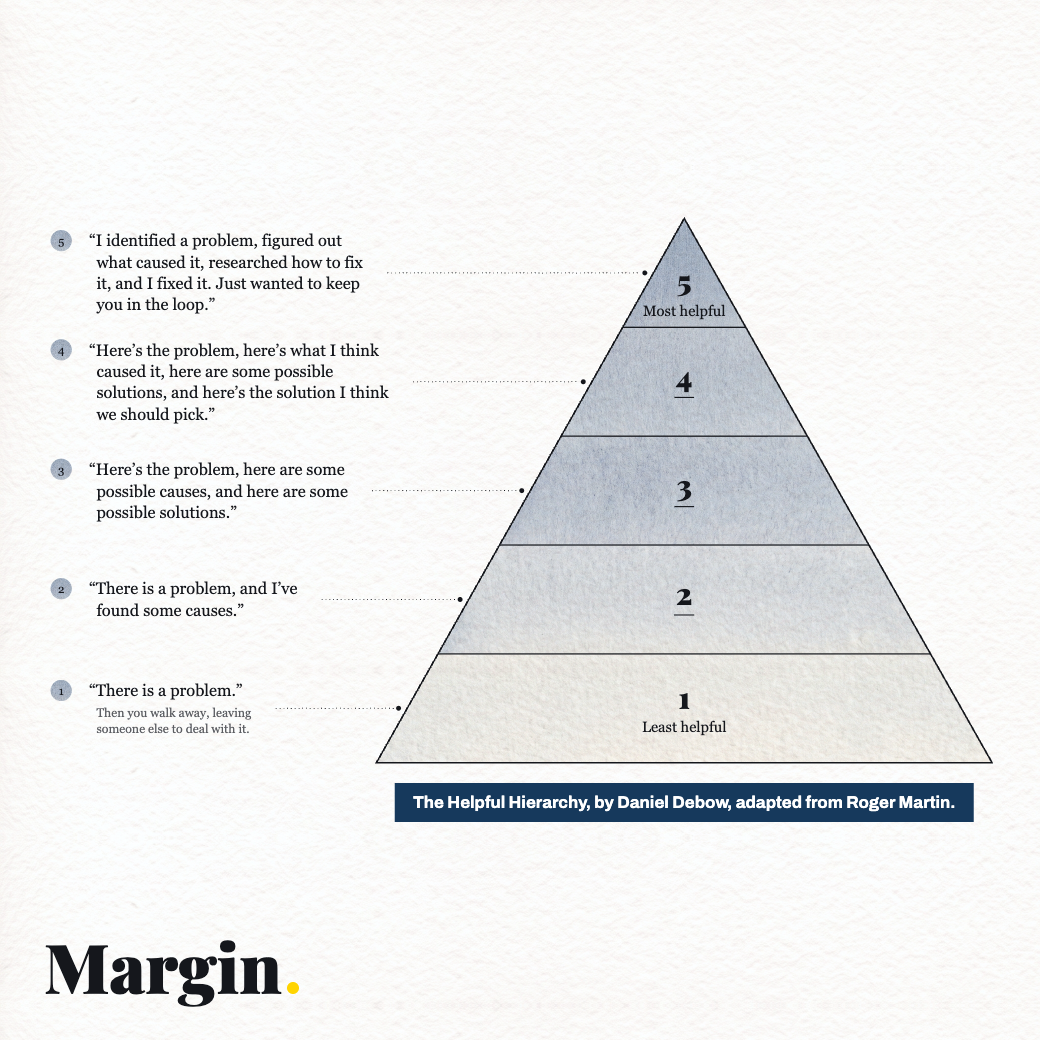
The room was reading both of them against a picture that's been all over LinkedIn: a pyramid of five levels of how someone brings you a problem, from "There is a problem" at the bottom to "...and I fixed it. Just wanted to keep you in the loop" at the top. It's one of the clearest pictures of high agency around, and I believe in what it's trying to teach.

The Helpful Hierarchy, by Daniel Debow, adapted from Roger Martin. A pyramid of five levels of how someone brings you a problem. Level 1, least helpful:

What I've been looking at is what happens to it when it crosses a border. In some places trust is earned by acting and telling your boss afterward, and in many others by making sure your boss hears it first and letting the fix carry more names than your own. The solution is the same, but it travels a route the pyramid can't see.

George Mack, whose essay did a great deal to popularize the idea of high agency, opens by asking who you would call if you woke up in a jail cell far from home. Whoever you picked, he says, has agency. Then he describes them: disagreeable, quick to act, unafraid to tell an authority figure no. Those traits are real, and they all assume a room where defying authority is safe. Ask the same question in many of the places I've worked and you hear a different name: the person who knows exactly whom to call, who can get a senior official to pick up the phone because they have protected that official's standing for years. That is agency too.

Erin Meyer's The Culture Map gives this a shape. On her scale for leading, cultures run from egalitarian to hierarchical. On her scale for communicating, from explicit to implicit. Move a leader along either one and the same behavior changes meaning. Going around your boss, for example, can read as a breach in a hierarchical office.

As AI takes on more of the execution, agency is becoming the trait every leadership team says it wants to hire and promote for. Whatever definition that team carries into the talent review becomes a filter, applied every cycle. If the team can only recognize one shape, every promotion cycle pulls the bench a little closer to that shape.

The people holding the pen in that review are usually the ones the pyramid already rewarded. I've come to think most of what gets called a culture clash is an authority problem in disguise. People weren't sure the call was theirs, so they moved it through the only channel that felt safe, and we scored the channel.
Hold this line
Before you decide someone lacks agency, find out whether they knew the call was theirs, and how they moved it when they didn't.
The move

This week, change what happens when a problem reaches you from the leaders who report to you. The next time one lands on your desk, whether it's a customer concession outside the usual margin, a global program that isn't landing in one market, or a partner who wants to renegotiate, hold your answer. Ask one question instead:

"If this were entirely yours, what would you do?"

Then let the answer come back by whatever route is safe for that leader. Some will send it in a note that evening. Some will bring it through a peer they trust, or save it for your next one-to-one, because where they learned to lead, proposing a fix in front of others takes a decision away from the boss. What you're asking for is the solution. Whether it comes as one decisive call or as three department heads aligned before anyone announces it, the route is theirs to choose.

When the solution works, credit it to them by name, in the room where it counts: your staff meeting or your own boss's review. In a hierarchical culture, public credit from above is what makes solving visible and safe to repeat. It tells every leader watching that bringing the answer is how people get seen here.

Expect friction. Some answers will arrive slower than you'd like, and some will be solutions you'd have designed differently. Take one you'd have designed differently at least once, and say so. That's how the question stops sounding like a test.

If you're the one being assessed, bring the answer with the problem, and ask your boss how they'd like to receive it: in the room, in writing, or before the meeting.

What comes back is a talent review that can see more than one shape of agency.

Agency comes in more than one shape.
Learn to see the others before you score them.
Whose agency have you been reading in only one shape? Hit reply and tell me. I read every reply.
See you Tuesday.
Rui
P.S.  Worth your margin: Erin Meyer's The Culture Map. The scales on leading and communicating explain most of what a single picture of agency can't see.
If someone came to mind while you were reading this, send it to them.
Someone forward this to you? Margin. is free, five minutes, every Tuesday.
Five minutes every Tuesday
Margin. · Nº 10
End of dispatch

Common questions

Nº 10

Why can a talent review miss high agency?

A talent review can read every leader against one picture: a pyramid of five levels of how someone brings you a problem, from "There is a problem" at the bottom to "...and I fixed it. Just wanted to keep you in the loop" at the top. In many places trust is earned by making sure your boss hears it first and letting the fix carry more names than your own. The solution is the same, but it travels a route the pyramid can't see.

What are Erin Meyer's scales for leading and communicating?

In The Culture Map, cultures run from egalitarian to hierarchical on her scale for leading, and from explicit to implicit on her scale for communicating. Move a leader along either one and the same behavior changes meaning. Going around your boss, for example, can read as a breach in a hierarchical office.

Why does the definition of agency matter more as AI takes on execution?

As AI takes on more of the execution, agency is becoming the trait every leadership team says it wants to hire and promote for. Whatever definition that team carries into the talent review becomes a filter, applied every cycle. If the team can only recognize one shape, every promotion cycle pulls the bench a little closer to that shape.

What gets called a culture clash?

I've come to think most of what gets called a culture clash is an authority problem in disguise. People weren't sure the call was theirs, so they moved it through the only channel that felt safe.

What can a leader do this week?

When a problem reaches you from one of the leaders who report to you, hold your answer and ask one question: "If this were entirely yours, what would you do?" Let the answer come back by whatever route is safe for that leader. When the solution works, credit it to them by name, in the room where it counts.

Keep Reading