| Margin. |
Field notes on leadership |
Nº 14 |
|
|
Dispatch · to the desk of one working leader
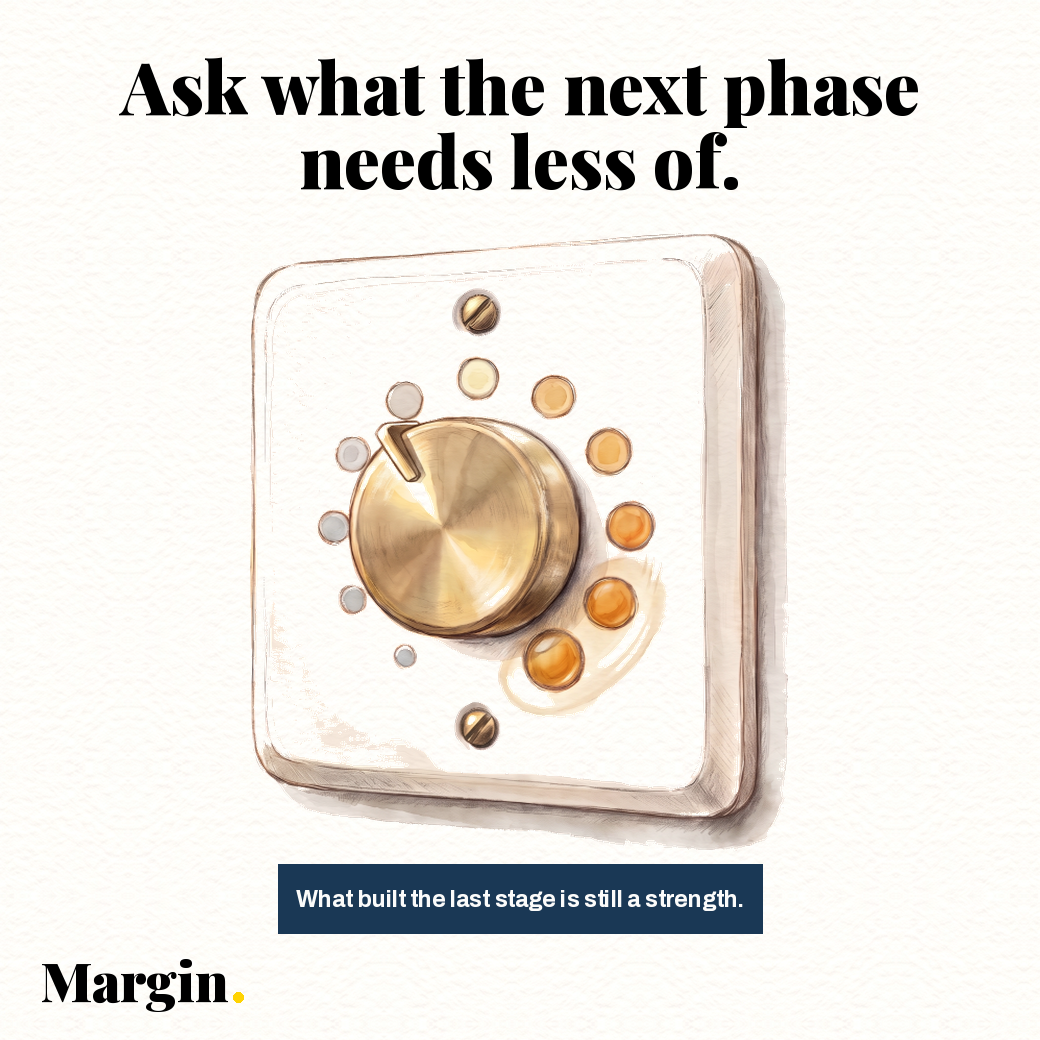
Ask what the next phase needs less of.
| Five minutes every Tuesday |
October 2026 |
|
|
The observation
At the end of a one-on-one, Marta stops at the door and asks, for the third time this month, whether the old forecast sheet can keep running alongside the new AI model, "just for a quarter or two." Five minutes earlier, she told you the move to the new model was going well and she was fully on board.
Her team trusts her numbers. When something in the forecast looks odd, people go to Marta, and she can usually say what changed before they finish the question. When Daniel set up the new AI model, which builds the monthly forecast straight from the raw data, Marta checked its first results row by row. They held up, and she came back with two pages of questions about where the model gets its numbers.
At this month's forecast review, both versions were on the table. The room spent the first ten minutes matching them line by line before anyone talked about what the numbers meant.
In most organizations, a change like this one moves the final word on the work, from the person who used to give it to a system that now produces it. Until someone says out loud where that person's word goes next, they keep a version of the old way running, because it's the one place their word still counts.
|
|
The pattern
Open pushback is easy to see. Hesitation is harder to spot when it arrives as a yes and a backup spreadsheet.
A study published in Harvard Business Review in February 2026, covering more than 2,000 employees in the United States and Europe, helps explain how a change can look finished while the backup keeps running. In the research by Erin Eatough, Keith Ferrazzi, Wendy Smith and Shonna Waters, 65% of respondents agreed that they "worry about being replaced by someone who knows how to use AI better than I do," and 60% worried that using AI would make colleagues question their competence.
Those who scored high on the authors' measure of AI angst said about 65% of their job was already AI-assisted, compared with about 42% among those who scored low, and they rated themselves more than twice as resistant to adopting AI at work. The authors' point is that heavy use and hesitation can live in the same person: Marta works from the new model's run every month and keeps her old sheet beside it, and only the first shows up when anyone checks on the change.
The authors write that AI adoption stalls "when the technology collides with how people understand their value, their risk, and their future." For Marta, that value sits in the work itself: she assembles the forecast by hand, and she knows where every number comes from. The model now does the assembling. What the team needs more of is her eye for whether a run makes sense, because someone has to vouch for the numbers before they go to the review. She'll bring that eye to the new model once she can see that job as hers.
Until she can, the old sheet keeps running. Marta updates it each month and reconciles it against Daniel's run before the review, spending hours she could use to pressure-test the new model.
|
|
Hold this line
Before you agree to keep a backup of the old process, ask the person requesting it what their own work will look like after the change.
|
|
The move
The moment. Your team is partway through a change, and the person who was best at the old way has just told you, again, that they're fully on board.
The check: what does the next phase need less of? Pick the person on your team most associated with the old way of working. Can you say which of their strengths the change will use less?
1. Describe where the change lands. In your next one-on-one, ask them how they picture the work once the change has settled, then fill in what they leave out, in plain terms: who builds the first version, what still gets checked by a person, and where the decisions get made. If the old way of working is going away, say when.
2. Ask what it needs less of. Tell them first that the team still relies on their expertise and you want to talk about where it goes next, then ask the question below and give them a full minute. If the answer is "nothing," name the part of the old routine the new process now handles, and ask what skill sat behind it.
3. Give the strength a new job. Ask where the strength they named could go now, and agree on one thing before you leave the room. Marta might take on the monthly check of the new model, testing the three or four assumptions that move the numbers most, putting her name on the sign-off, and picking a date with you to retire the old sheet.
Say this: "What do you do well that this next phase needs less of?"
What it costs. This takes longer than a status check, and the honest answer might point at one of your own habits too. After the retirement date you picked together there's no old sheet to fall back on, and the first few monthly checks will take Marta longer than building it did. Daniel will also notice that his model now gets a named monthly check, so tell him why before the first one.
If you're on the team: ask yourself the same question before your next one-on-one, and bring your answer with you.
Tell me what happened. Which strength came up first? I read every reply.
|
|
What built the last stage is still a strength.
Ask where it belongs in the next one.
See you Tuesday.
Rui
|
P.S. Worth your margin: " Why AI Adoption Stalls, According to Industry Data," by Erin Eatough, Keith Ferrazzi, Wendy Smith and Shonna Waters, Harvard Business Review, February 2026. It sorts employees into four groups by how much they believe in AI and how much personal risk they see in it.
|
|
If someone came to mind while you were reading this, send it to them.
Someone forward this to you? Margin. is free, five minutes, every Tuesday. |
Five minutes every Tuesday
Margin. · Nº 14 |
End of dispatch |
|
|