Margin. Field notes on leadership Nº 12
Dispatch · to the desk of one working leader
Asking for help takes courage.
Five minutes every Tuesday October 2026
The observation

It's seven on Thursday evening, and you're clearing your inbox so your team can start Friday without bottlenecks. The deck for Monday's review is still open in another tab. You'll get back to it after the last reply goes out.

Your calendar this week was all escalations: a customer complaint that reached the CEO on Tuesday, and two colleagues who needed you in the room before they could agree on what to do about a late shipment. You gave up the session with your own coach to calm an anxious stakeholder, and you moved your strategic planning block to Sunday morning. That's the job as most leaders have been taught it: take the pressure so the organization can keep working.

On Friday morning, the strongest person on your team brings you a tricky vendor dispute. She has laid out two options on one page and wants to think them through with you. You can't see the angles this morning, so you pick the faster option and end the meeting 10 minutes early. She thanks you and goes back to her desk with a quick answer.

Now multiply that Friday morning across every leader in your organization. When each of them decides to act as a shield, the company stops thinking strategically. A company run by exhausted leaders gets slower at spotting risks and catching new opportunities, and plans get approved with fewer questions. Over a few months, strategic work slides to Sunday mornings for everyone.

The pattern

Airline safety briefings carry a line most travelers can recite: "Secure your own mask before assisting others." It's written for the parent whose first instinct is to reach for the child beside them, and plenty of leaders bring that same instinct to work, where it tends to be praised.

World Mental Health Day fell on 10 October, a good moment to ask yourself how you're doing. For many leaders that question comes up late, often on a Sunday evening with the laptop already open and next week's calendar on the screen.

Answering that out loud can still feel risky at work. The National Alliance on Mental Illness (NAMI), the largest grassroots mental health organization in the US, ran a poll with Ipsos in early 2026. Of the 2,153 US full-time employees surveyed, one in three said sharing about their mental health might make them seem weak, and 46% of the managers worried about the career impact of talking about it.

Asking for help isn't a sign of weakness, and neither is telling people how you're doing. Both take courage. Asking can sound ordinary: "I'm stretched this week. Could you take the supplier call on Thursday?" Teams usually follow the example their leader sets. A line like that makes it easier for the rest of the team to say the same.

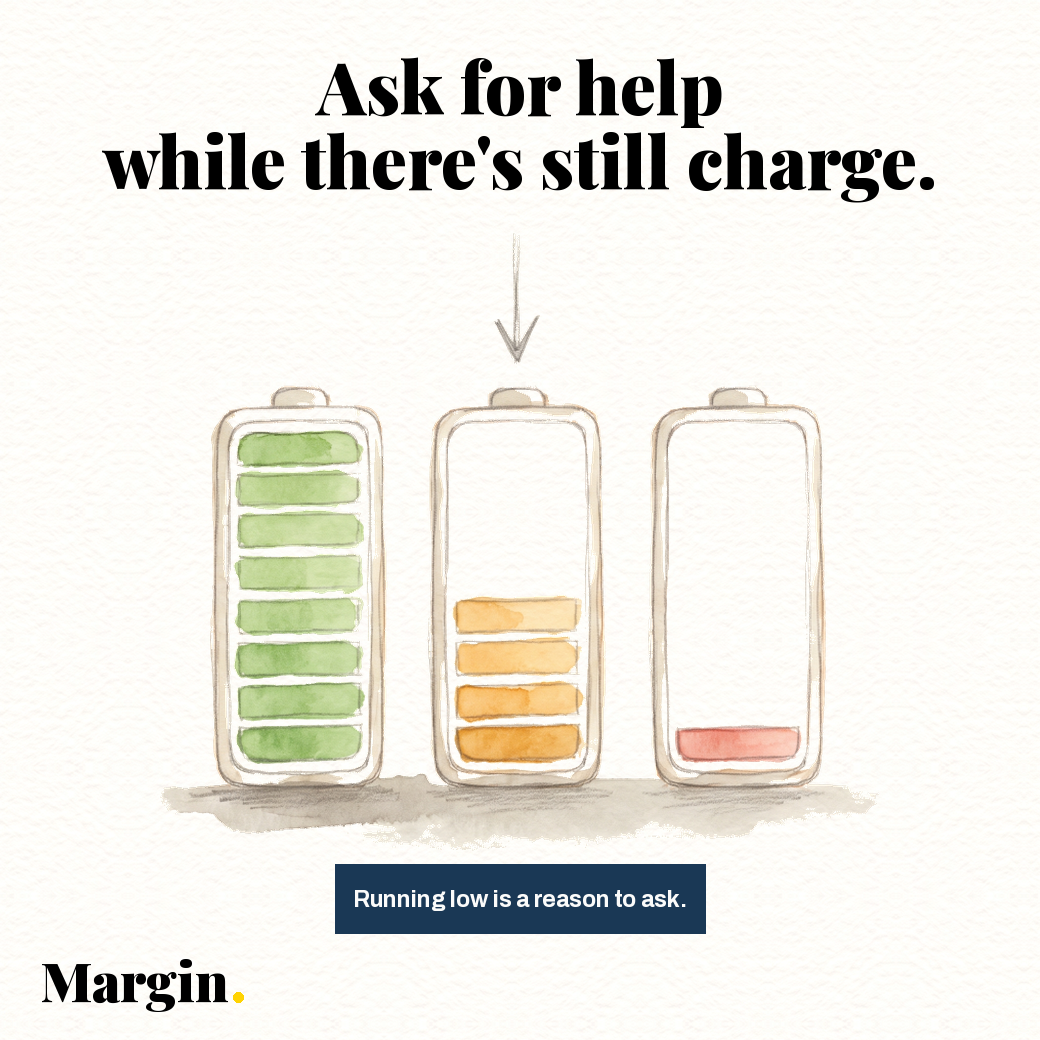
Three hand-drawn watercolor batteries stand side by side: the first full and green, the second half full and amber with a pencil arrow pointing down at it, the third nearly empty with one thin red bar. The headline reads Ask for help while there's still charge, and the label reads Running low is a reason to ask.

Because laptops and phones keep the inbox open, ending the working day has become a decision you have to make for yourself.

Hold this line
When the week asks for your last free hour, keep it, so you can think clearly when Friday's hard problem arrives.
The move

The moment. Next week, someone will ask for the hour you set aside for yourself.

The check: whose mask is on? Look at next week and find one block that is there for you, to think or to rest. If there isn't one, you're helping everyone else first.

1. Put your own mask on first. Pick a time that ends your working day and keep it, starting with one night a week. If this week's evenings are already taken, pick next Tuesday and put it in the calendar now. On that night, charge your phone outside the bedroom so the inbox waits until morning. Put the session with your coach and your planning block back in the week, where they were, and mark both as fixed so they stop being the first things to move when an escalation comes in.

2. Ask for help out loud. Choose one thing you've been carrying alone that someone on your team is ready to own, like the deck you were going to rebuild on Sunday, and hand it to them. Or tell a peer you trust that you're running low. A two-line message on Thursday afternoon will do.

Say this: "I'm running low this week, so I'm keeping this evening for myself. I'll pick up anything urgent first thing tomorrow."

What it costs. A few emails wait until the morning, and you trust a colleague to make a Friday decision without checking with you first. In most weeks, that's a fair trade for a clearer head when the vendor dispute comes back.

If you're on the team: offer to take one specific thing off your leader's week, like running the Thursday supplier call, and say it in a sentence they can answer with a yes. "I can take the supplier call on Thursday" is enough.

Tell me what happened. Try it this week and reply with the one hour you kept, and what you did with it. I read every reply.
Help yourself first.
Then you can help the people you lead.
See you Tuesday.
Rui
P.S.  Worth your margin: the National Alliance on Mental Illness (NAMI) and Ipsos, "2026 Workplace Mental Health Poll". The findings on managers are the part worth reading closely.
If someone came to mind while you were reading this, send it to them.
Someone forward this to you? Margin. is free, five minutes, every Tuesday.
Five minutes every Tuesday
Margin. · Nº 12
End of dispatch
Margin. Field notes on leadership Nº 12

Common questions

Why does strategic work slide to Sunday mornings for leaders?

Most leaders have been taught that the job is to take the pressure so the organization can keep working. When each of them decides to act as a shield, the company stops thinking strategically. A company run by exhausted leaders gets slower at spotting risks and catching new opportunities, and plans get approved with fewer questions. Over a few months, strategic work slides to Sunday mornings for everyone.

What did the 2026 NAMI and Ipsos workplace mental health poll find?

The National Alliance on Mental Illness (NAMI), the largest grassroots mental health organization in the US, ran a poll with Ipsos in early 2026. Of the 2,153 US full-time employees surveyed, one in three said sharing about their mental health might make them seem weak, and 46% of the managers worried about the career impact of talking about it.

Why has ending the working day become a leader's own decision?

Because laptops and phones keep the inbox open, ending the working day has become a decision you have to make for yourself.

Does asking for help at work take courage?

Yes. Asking for help takes courage, and so does telling people how you're doing.

What can a leader do when they're running low?

Look at next week and find one block that is there for you, to think or to rest. Pick a time that ends your working day and keep it, starting with one night a week. Then ask for help out loud: hand one thing you've been carrying alone to someone on your team who is ready to own it, or tell a peer you trust that you're running low. Asking can sound ordinary: "I'm stretched this week. Could you take the supplier call on Thursday?"

Keep Reading