Margin. Field notes on leadership Nº 16
Dispatch · to the desk of one working leader
Every hill your team climbs has an owner.
Five minutes every Tuesday November 2026
The observation

It's seven in the evening in the last week of the quarter, and you're at your desk with three spreadsheets open while dinner waits at home. The sales figure in the system of a business your company bought doesn't match what your company's main system shows for the same sales, and headquarters reports one number on Friday. You decide to find the gap before you leave, and you open the acquired company's system again, starting with the columns you know to check first. By eight you've found it: a currency conversion that one system applies and the other doesn't.

You've done this every quarter since the second acquisition brought in a third system. Your team knows every gap by heart, and when someone new joins, you teach them which system to trust when two systems disagree. On Friday the numbers go out on time.

In a quarterly business review, someone asked why it takes eight days to finalize the quarter's numbers. You had a clear answer ready, and it was about the three systems.

Companies that grow by acquisition end up here often. Each purchase brings its own finance software, and each system ends up with people who know its quirks. The workarounds pile up one quarter at a time, and each one makes sense on the day someone builds it. Moving everything onto one system goes on next year's plan, and then the following year's.

The pattern

A full calendar looks like a team on the right track. Often it's a team that has gotten very good at climbing a hill it no longer needs to climb.

People like being busy, and they will find a reason to stay that way. Researchers led by Christopher Hsee of the University of Chicago gave students a 15-minute wait between two surveys. They could hand in the first survey just outside the room, or walk 12 to 15 minutes round trip to a farther spot. When the candy waiting at both spots was the same, 32% made the walk. When the farther spot offered a different candy, about 59% did, according to Chicago Booth Review's write-up, and across the studies the people who kept busy felt happier than the people who sat idle. In their 2010 paper in Psychological Science, "Idleness Aversion and the Need for Justifiable Busyness," Hsee and his colleagues Adelle Yang and Liangyan Wang wrote that "many purported goals that people pursue may be merely justifications to keep themselves busy."

Three systems that must agree by Friday give a team a far more serious reason for busyness. The work always looks necessary. Making them agree is a real skill, and it often earns recognition.

Before every quarter-end, the person running it has the same thought: "If I spend a month making the case for one system, who finalizes the numbers in the meantime?"

AI tools now take over some of the matching, and that hands hours back to the team, hours that could go to the work it keeps postponing. Each quarter-end goes a bit faster, and running three systems feels more like the normal way to work.

So next quarter the climb starts over, without anyone stopping to ask: am I climbing the right hill?

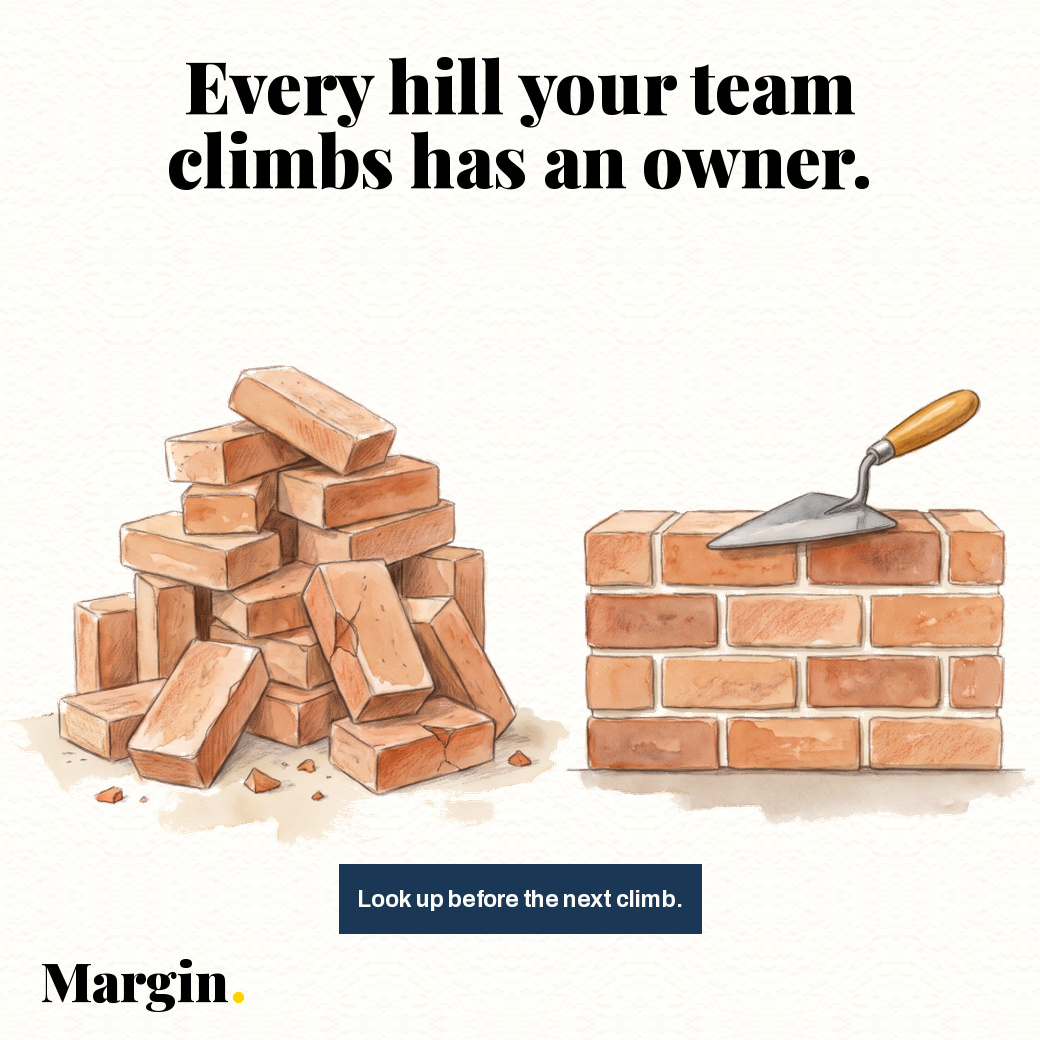
A watercolor of a loose heap of terracotta bricks, some broken, beside a short brick wall laid in neat rows with a mason's trowel resting on top. Headline: Every hill your team climbs has an owner. Label: Look up before the next climb.
Hold this line
Before you speed up work your team repeats every quarter, ask what it's for.
The move

The moment. Your team has just finished a hard quarter-end on time, and someone suggests a way to make next time faster.

The check: which hill is your team on? Pick the recurring work that took the most of your team's time last quarter.

1. Name the hill. Put that whole process on the agenda of your next team meeting, and write down every reason people give for it.

2. Count the climb. Add up the hours it took last quarter. Ask each person for an estimate; a rough count is enough. Put the total next to one piece of work the team keeps postponing.

3. Take the hill to whoever chose it. If the reasons trace back to your team's own habits, you own the fix. If they trace back to a decision above you, like running several systems, bring the hours and the postponed work to the person who owns that decision, and ask for a date to talk it through.

Say this: "This took us [the hours] last quarter. What would we do with that time if we stopped?"

What it costs. One meeting and a few conversations to get the hours. The people who built the workarounds will feel any change most, so give them a role in the move. A switch to one system takes months, and both setups run side by side while it happens. Some counts will show the climb is worth it for now. Share that with the team as well.

If you're on the team: run step 2 yourself and bring the number to your next one-on-one.

Tell me what happened. Run step 1 with your team this month, and reply with the hill you found. I read every reply.
A full week is no proof of the right hill.
Look up before the next climb.
See you Tuesday.
Rui
P.S.  Worth your margin: "Idle Trap," Chicago Booth Review, on Christopher Hsee's research with Adelle Yang and Liangyan Wang. Read the part about airports moving baggage claim farther from the gates.
If someone came to mind while you were reading this, send it to them.
Someone forward this to you? Margin. is free, five minutes, every Tuesday.
Five minutes every Tuesday
Margin. · Nº 16
End of dispatch
Margin. Field notes on leadership Nº 16

Common questions

Why do quarter-end workarounds keep piling up after an acquisition?

When a company grows by acquisition, each purchase brings its own finance software, and each system ends up with people who know its quirks. The workarounds pile up one quarter at a time, and each one makes sense on the day someone builds it. Moving everything onto one system goes on next year's plan, and then the following year's.

What is idleness aversion?

People like being busy, and they will find a reason to stay that way. Researchers led by Christopher Hsee of the University of Chicago gave students a 15-minute wait between two surveys. They could hand in the first survey just outside the room, or walk 12 to 15 minutes round trip to a farther spot. When the candy waiting at both spots was the same, 32% made the walk. When the farther spot offered a different candy, about 59% did, according to Chicago Booth Review's write-up. In their 2010 paper in Psychological Science, "Idleness Aversion and the Need for Justifiable Busyness," Hsee and his colleagues Adelle Yang and Liangyan Wang wrote that "many purported goals that people pursue may be merely justifications to keep themselves busy."

What happens when AI tools speed up a team's quarter-end work?

AI tools now take over some of the matching between systems, and that hands hours back to the team, hours that could go to the work it keeps postponing. Each quarter-end goes a bit faster, and running several systems feels more like the normal way to work.

When should a team question work it repeats every quarter?

Before you speed up work your team repeats every quarter, ask what it's for.

What can a leader do about the recurring work that takes most of the team's time?

Start by putting that whole process on the agenda of your next team meeting and writing down every reason people give for it. A rough count of last quarter's hours, with an estimate from each person, gives you a total to set next to one piece of work the team has put off. If the reasons trace back to your team's own habits, you own the fix. If they trace back to a decision above you, the hours and the postponed work go to the person who owns that decision, with a request for a date to talk it through. Some counts will show the recurring work is worth it for now.

Keep Reading