For most of a career, being across everything took real hours. You read late, you sat in the room, you asked around, and the people who managed all of it were usually the people who cared most. Being needed everywhere became an honest reading of being valuable, and for a long time the two were the same measurement.
What changed is the hours. AI took the writing-up, the summarizing, the chasing, the assembling of what everybody already knew, and it handed that time back. Generously, and to almost everyone at once. It's the first real surplus most leaders have been handed in a working lifetime.
So there's a question about what the hours get spent on, and a larger one underneath it. Your worth was never in how much reached you. It's in how much no longer has to.
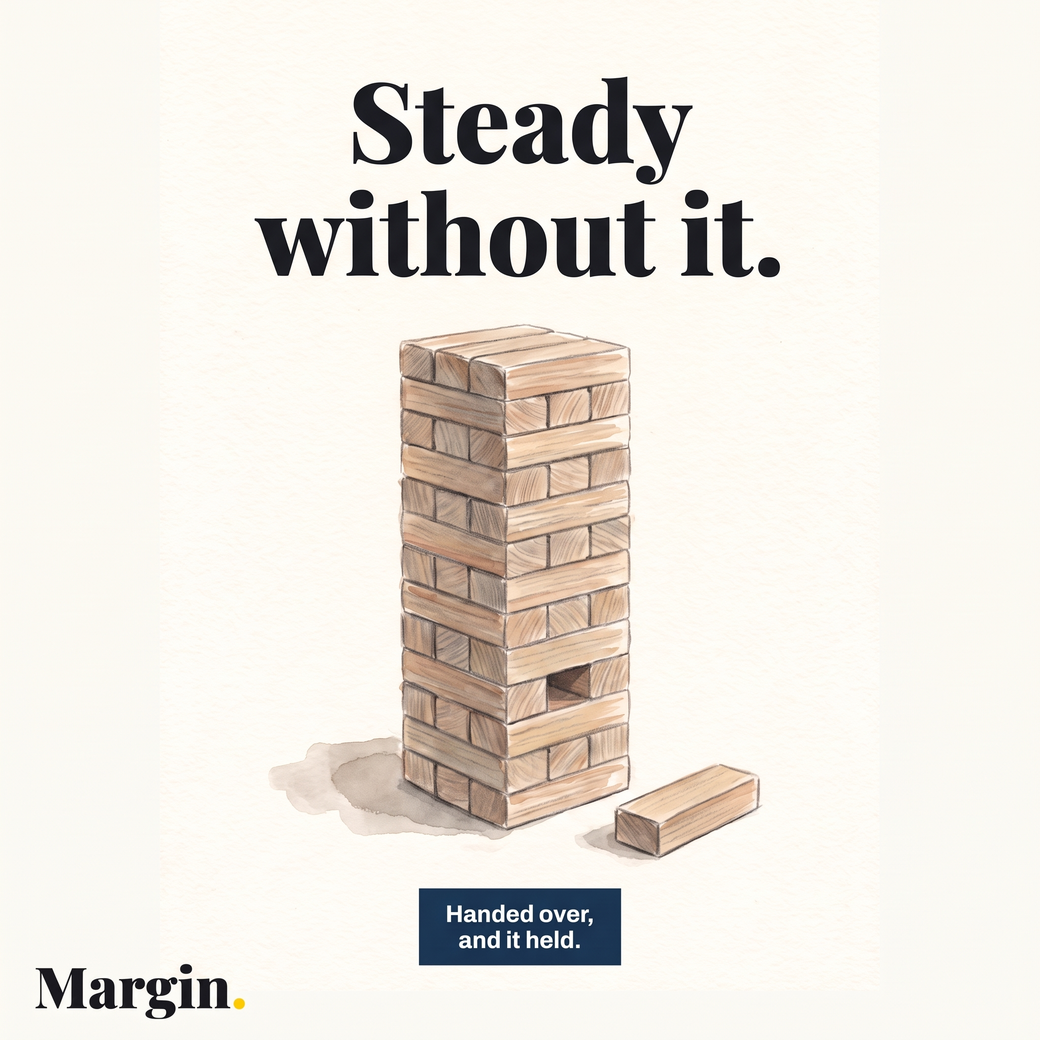
The old measurement rewarded presence, and the pull runs that way, toward being in more places. The spend worth making is the one that leaves you needed in fewer.
And look at where the work actually slows. It slows where something finished sits and waits, for a view, a nod, a signature, a Thursday. Every one of those pauses is friction, and every one is there because a decision still belongs to somebody who isn't in the room. Trust is what takes them out, and you can see it in the record as an absence: the pause that didn't happen.
Anil Dash put the phrase down in July 2012, as an answer to the fear of missing out. That term is older than people assume: Patrick McGinnis coined it in 2004, in a humor column in the Harvard Business School student paper, and by 2011 it was everywhere. Dash wanted a name for the opposite feeling.
"There can be, and should be, a blissful, serene enjoyment in knowing, and celebrating, that there are folks out there having the time of their life at something that you might have loved to, but are simply skipping."
Read that as a leader and it lands somewhere else entirely. The joy on offer is hearing that something went well and knowing you had no hand in it. The word Dash reaches for is celebrating.
Gavin Slemp and colleagues published a meta-analysis in Motivation and Emotion in 2018, drawing 754 correlations from 72 studies and 32,870 people. Leaders who support autonomy have teams that report higher engagement, better well-being and less distress, and the result held across countries.
Empowerment has a price on the other side too. A decision that's really theirs is one they can't hand back on the Thursday it turns, and some people will want to. So the half second in the car is a list of what you're still carrying for somebody who's ready to carry it.